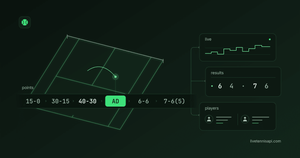
Tennis Tiebreak Rules: Complete Guide to How It Works, Scoring & Strategy (2026)
The tennis tiebreak is one of the most exciting moments in the sport — a sudden-death shootout that decides a set when both players or teams have won 6 games each. Understanding the tennis tiebreak rules is essential for any player, whether you’re a complete beginner or a seasoned club player. This complete guide covers everything you need to know: how a tiebreak works, the scoring system, serving order, the match tiebreak, and the different tiebreak rules used at Grand Slams.
🎾 Elite Tennis Coaching Programs — At Affordable Prices
The internet has made world-class tennis coaching accessible to everyone. The same coaches behind 5 World No.1 players — including Martina Navratilova — now offer structured online programs for players of all levels.
See All Coaching Programs →What Is a Tiebreak in Tennis?
A tennis tiebreak is a special game played when a set reaches 6-6. Instead of continuing to play regular games, both players play a tiebreak to decide the set. The tiebreak replaces what would otherwise be an endless set — before tiebreaks were introduced, sets could theoretically go on forever.
The tiebreak was invented by James Van Alen and first used at the US Open in 1970. It has since become a standard part of the game at all levels, though the exact rules vary slightly between tournaments and formats.
Tennis Tiebreak Rules: How It Works
The standard tennis tiebreak rules are:
- A tiebreak is played when a set reaches 6-6
- The first player or team to reach 7 points wins the tiebreak — and the set 7-6
- You must win by 2 points — if the score reaches 6-6 in the tiebreak, play continues until one player leads by 2 (e.g. 8-6, 9-7, 10-8)
- Points are counted as 1, 2, 3, 4… (not 15, 30, 40) during the tiebreak
- The player whose turn it is to serve starts the tiebreak with one serve from the right side (deuce court)
- After the first point, each player serves 2 consecutive points, alternating sides
- Players change ends every 6 points during the tiebreak
Tennis Tiebreak Serving Order
The serving order in a tennis tiebreak is one of the most commonly misunderstood rules. Here’s exactly how it works:
- Player A serves 1 point (from the right/deuce side)
- Player B serves 2 points (first from the left/ad side, then right/deuce side)
- Player A serves 2 points
- Player B serves 2 points
- Continue alternating every 2 points until the tiebreak is won
In doubles, the serving order follows the same pattern but alternates between the four players according to the serving order established during the set.
Changing Ends During a Tiebreak
Under standard tennis tiebreak rules, players change ends after every 6 points played in the tiebreak. This ensures neither player has a sustained advantage from wind, sun, or court conditions. After the tiebreak, players also change ends before the start of the next set.
The Match Tiebreak (Super Tiebreak)
The match tiebreak — also called the super tiebreak or championship tiebreak — is a longer tiebreak used as a final set in some formats instead of playing a full third set. The rules are:
- First to 10 points wins (not 7)
- Must win by 2 points
- Same serving rotation as a standard tiebreak (1 serve, then 2 serves alternating)
- Players change ends every 6 points
The match tiebreak is used at the Australian Open, US Open, and Wimbledon in the final set (at 6-6), and is standard in doubles at most ATP and WTA events. It’s also widely used in recreational and club tennis to keep matches to a manageable length.
Grand Slam Tiebreak Rules
Each Grand Slam has slightly different tennis tiebreak rules for the final set:
| Grand Slam | Final Set Rule |
|---|---|
| Australian Open | Match tiebreak at 6-6 (first to 10 points) |
| French Open | Standard tiebreak at 6-6 (first to 7 points) |
| Wimbledon | Standard tiebreak at 6-6 (first to 7 points) |
| US Open | Standard tiebreak at 6-6 (first to 7 points) |
The French Open was the last Grand Slam to introduce a final-set tiebreak, doing so in 2022. Before that, the French Open final set was played without a tiebreak — meaning sets could go on indefinitely. The longest final set in Grand Slam history was the Isner-Mahut match at Wimbledon 2010, which lasted 70-68 before tiebreaks were introduced at that stage.
🎾 Improve Your Tennis Game
Top-rated rackets, balls, and training guides to help you win more tiebreaks.
 Babolat Rackets →
 Tennis Balls →
As an Amazon Associate, we earn from qualifying purchases.
Tiebreak Strategy: How to Win More Tiebreaks
The tennis tiebreak is as much a mental battle as a physical one. Here’s how to approach it:
Serve Big on Your First Point
The first point of the tiebreak sets the tone. Go for a strong first serve — a mini-break at the start of a tiebreak is psychologically significant and hard to recover from.
Play Your Patterns
A tiebreak is not the time to try new shots. Stick to your best patterns — the shots and tactics that have worked throughout the match. Tiebreaks are won by executing your strengths, not experimenting.
Stay in the Present
The biggest mental mistake in a tennis tiebreak is thinking about the score rather than the next point. Each point is its own battle. Focus on one point at a time — especially when you’re ahead. Many players tighten up at 6-3 and lose the tiebreak from a winning position.
Use Your Best Serve
In a tiebreak, you serve twice in a row (except for the first point). Use your most reliable serve — not necessarily your fastest. A consistent serve that stays in is worth far more than a powerful serve that double faults at 6-6.
Return Aggressively
Mini-breaks (winning a point on your opponent’s serve) are the currency of tiebreaks. Be aggressive on return — take the ball early, go for your spots, and put pressure on your opponent’s serve from the first point.
🎾 Win More Tiebreaks with the Right Mental Game
The Complete Tennis Bundle — drills, footwork, mental game, and everything you need to perform under pressure.
 Get the Complete Tennis Bundle →
Frequently Asked Questions: Tennis Tiebreak Rules
How does a tennis tiebreak work?
A tennis tiebreak is played when a set reaches 6-6. The first player to reach 7 points (winning by 2) wins the tiebreak and the set 7-6. Points are counted 1, 2, 3… (not 15, 30, 40). The first server serves one point, then players alternate serving every 2 points. Players change ends every 6 points.
Who serves first in a tennis tiebreak?
The player whose turn it is to serve at 6-6 serves the first point of the tennis tiebreak from the right (deuce) side. After that first point, the other player serves 2 points, and they continue alternating every 2 points.
What is a match tiebreak in tennis?
A match tiebreak (super tiebreak) is a longer tiebreak played to 10 points (win by 2) instead of 7. It’s used as a final set in some formats — including at the Australian Open, and in doubles at most professional events. It’s also popular in recreational tennis to keep matches to a manageable length.
What are the tiebreak rules at Wimbledon?
Wimbledon uses a standard tennis tiebreak (first to 7 points, win by 2) when the final set reaches 6-6. Before 2019, Wimbledon had no final-set tiebreak — which led to the famous Isner-Mahut match lasting 70-68 in the fifth set.
Is a tiebreak played in every set?
In most recreational and professional formats, a standard tennis tiebreak is played at 6-6 in every set. However, some formats — particularly older Grand Slam rules — used advantage sets in the final set with no tiebreak. All four Grand Slams now use a tiebreak or match tiebreak in the final set.