How to Play Pickleball: Complete Beginner's Guide to Rules, Scoring & Tips (2026)
How to play pickleball is one of the most searched questions in racket sports right now — and for good reason. Pickleball is the fastest-growing sport in the world, and it's genuinely one of the easiest sports to pick up at any age. Within 30 minutes of your first session, most beginners are rallying, scoring, and having fun. This complete guide covers everything you need to know about how to play pickleball: the court, equipment, rules, scoring, serving, the kitchen, and tips to get started fast.
🏓 Elite Pickleball Training Programs — At Affordable Prices
The same coaches behind 5 World No.1 tennis players — including Martina Navratilova — now offer structured pickleball fitness, mobility and injury prevention programs for players of all ages and levels. Use code TM888 for 10% off.
See Pickleball Programs →What Is Pickleball?
Pickleball is a paddle sport played on a small court with a perforated plastic ball over a low net. It combines elements of tennis, badminton, and ping-pong into a fast, social, and highly addictive game. It can be played as singles or doubles, indoors or outdoors, and is suitable for all ages and fitness levels.
The sport was invented in 1965 on Bainbridge Island, Washington, and has grown from a backyard game to a global phenomenon with over 36 million players in the US alone.
Pickleball Equipment: What You Need
To learn how to play pickleball, you need minimal equipment:
- Pickleball paddle: A solid paddle made from composite, graphite, or carbon fibre. Smaller and lighter than a tennis racket. Top pickleball paddles — Selkirk, Joola, Franklin & Paddletek →
- Pickleball: A hard perforated plastic ball with holes. Outdoor balls have smaller holes; indoor balls have larger holes. Top pickleball balls →
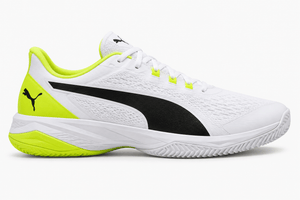
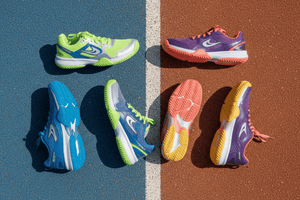
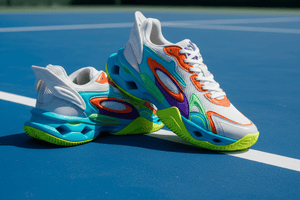
- Court shoes: Any court shoe with lateral support works. Dedicated pickleball shoes offer the best grip and stability. Pickleball shoes men → • Pickleball shoes women →
- Net: A portable pickleball net is 34 inches at the centre and 36 inches at the posts. Portable pickleball net →
The Pickleball Court
Understanding the court is the first step in learning how to play pickleball:
- Court size: 13.41 m x 6.10 m (44 ft x 20 ft) — the same size as a doubles badminton court
- Net height: 86 cm (34 inches) at the centre, 91.4 cm (36 inches) at the posts
- The kitchen (non-volley zone): A 2.13 m (7 ft) zone on each side of the net — the most important area on the court
- Service boxes: Two diagonal service boxes on each side, similar to tennis
- Baseline: The back line of the court where the server stands
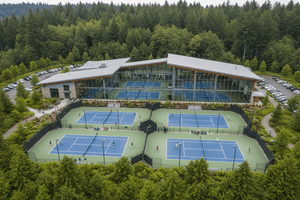
Pickleball courts can be set up on any flat surface — tennis courts, basketball courts, driveways, or dedicated pickleball facilities. Many tennis courts are now dual-lined for pickleball.
🏓 Get Started with Pickleball Today
Everything you need to get on court — paddles, balls, net, and shoes.
 Pickleball Balls →
  Pickleball Shoes (Men) →
 Pickleball Shoes (Women) →
As an Amazon Associate, we earn from qualifying purchases.
How to Play Pickleball: The Basic Rules
The Serve
Every point in pickleball starts with a serve. Here's how to serve correctly when learning how to play pickleball:
- The serve must be underhand — the paddle must contact the ball below the waist
- The server must stand behind the baseline
- The serve must land in the diagonal service box, beyond the kitchen
- There is only one serve attempt — no second serve like in tennis
- A let serve (clips the net and lands in) is played, not replayed
The Double Bounce Rule
The double bounce rule is one of the most important rules to understand when learning how to play pickleball:
- After the serve, the receiving team must let the ball bounce before returning
- After the return, the serving team must also let the ball bounce before playing it
- After these two bounces, both teams may volley (hit before the bounce) or play off the bounce
This rule prevents the serving team from rushing the net immediately and creates the strategic third-shot situation that defines competitive pickleball.
The Kitchen (Non-Volley Zone)
The kitchen is the 7-foot zone on each side of the net — and understanding it is essential to how to play pickleball correctly:
- You cannot volley the ball (hit it before it bounces) while standing in the kitchen
- You cannot step into the kitchen as a result of your volley momentum
- You CAN enter the kitchen to play a ball that has bounced in it
- You must exit the kitchen before volleying again
The kitchen rule is what makes pickleball unique — it prevents players from camping at the net and smashing every ball, creating the dinking game that defines high-level pickleball.
Faults
A fault ends the rally and results in a side-out or point. Common faults when learning how to play pickleball:
- Ball lands out of bounds
- Ball hits the net
- Volleying from the kitchen
- Violating the double bounce rule
- Serving fault (wrong box, into kitchen, foot fault)
How to Score in Pickleball
Scoring is one of the most important things to understand when learning how to play pickleball:
Traditional Scoring
- Only the serving team can score a point
- If the receiving team wins the rally, they win the serve — but not a point
- Games are played to 11 points, win by 2
- Tournament matches are sometimes best of 3 games to 11
Doubles Score Calling
In doubles, the score is called as three numbers: server score – receiver score – server number. Example: "4-2-1" means the serving team has 4 points, the receiving team has 2, and it's the first server's turn. At the start of the game, only one player on the first serving team serves (called "server 2 start") to prevent the serving team from having too large an advantage.
Basic Pickleball Shots to Learn
Once you understand how to play pickleball from a rules perspective, these are the key shots to develop:
The Dink
The dink is a soft shot played from near the kitchen line that lands in the opponent's kitchen. It's the most important shot in pickleball — the foundation of the net game. Most recreational players underestimate the dink; most advanced players build their entire game around it.
The Third Shot Drop
After the serve and return (the first two shots), the serving team needs to get to the net. The third shot drop is a soft shot that lands in the kitchen, giving the serving team time to advance. It's the most important strategic shot in pickleball.
The Drive
A hard, flat shot hit from the baseline. Used to put pressure on opponents or as an alternative to the third shot drop when the opportunity arises.
The Lob
A high shot over opponents at the net. Effective when opponents are crowding the kitchen line but risky if not executed well.
The Erne
An advanced shot where a player jumps around the kitchen post to volley a ball. Spectacular when executed correctly — something to work towards as you develop beyond the basics of how to play pickleball.
🏓 Master Pickleball Faster
50+ structured drills, footwork patterns, and a complete training system — everything you need to go from beginner to confident player.
 Get the Pickleball Made Easy Collection →
Pickleball Tips for Beginners
- Get to the kitchen line: The team at the net wins most points. After the double bounce rule is satisfied, move forward to the kitchen line as quickly as possible
- Dink more than you drive: Patience wins pickleball. Soft dinks force errors; hard drives often go out or pop up for easy put-aways
- Watch the ball: Keep your eyes on the ball all the way to your paddle — most beginner errors come from looking up too early
- Serve deep: A deep serve pushes your opponent back and gives you more time to get into position
- Call the score before every serve: It's a rule — and it helps you stay focused and avoid confusion
- Stay out of no man's land: The mid-court area between the baseline and kitchen is the most dangerous place to be. Move forward or stay back — don't get caught in the middle
Frequently Asked Questions: How to Play Pickleball
How long does it take to learn how to play pickleball?
Most beginners can learn the basic rules of how to play pickleball in under 30 minutes and be rallying and scoring within their first session. Developing real competence takes a few weeks of regular play. The sport is genuinely one of the easiest to pick up at any age.
Is pickleball easy to learn?
Yes — pickleball is one of the easiest racket sports to learn. The court is small, the ball moves slowly, the rules are simple, and the underhand serve is easy to execute. Most beginners are playing real points within minutes of their first session.
Can you play pickleball on a tennis court?
Yes — pickleball is commonly played on tennis courts. A standard tennis court can fit 4 pickleball courts. Many facilities dual-line their tennis courts for pickleball. You'll need a portable net or to lower the existing tennis net by 2 inches at the centre.
What is the kitchen in pickleball?
The kitchen is the non-volley zone — a 7-foot area on each side of the net. You cannot volley the ball while standing in the kitchen. It's the most important rule to understand when learning how to play pickleball and the rule that most beginners violate first.
How is pickleball different from tennis?
Pickleball uses a smaller court, a solid paddle instead of a strung racket, a perforated plastic ball, underhand serving, a non-volley zone (kitchen), and simpler scoring (first to 11, win by 2). It's easier to learn than tennis and more social at recreational level. See our full Pickleball vs Tennis comparison →