Padel vs Pickleball: Paddle Ball vs Pickle Ball — Which Racket Sport Is Right for You?
Partager
Padel and pickleball are two of the fastest-growing racket sports in the world. Both are fun, social, and easy to pick up at any age. But the difference between paddle tennis and pickleball goes deeper than most people realise. A common question is: is paddle tennis the same as pickleball? The short answer is no — they are distinct sports with different courts, balls, rules, and equipment. Players also often ask about paddleball vs pickleball — and while paddleball is a separate sport, the comparison helps clarify what makes pickleball unique. When it comes to pickle ball vs paddle sports like padel, the differences in court size, ball type, and rules are significant enough that the two should never be confused. This guide breaks down everything — court size, rules, scoring system, equipment, and which sport suits you best. If you've ever wondered whether to choose paddle or padel, or how these sports compare to pop tennis and platform tennis, read on.
🏓 Elite Pickleball Training Programs — At Affordable Prices
The same coaches behind 5 World No.1 tennis players — including Martina Navratilova — now offer structured pickleball fitness, mobility and injury prevention programs for players of all ages and levels. Use code TM888 for 10% off.
See Pickleball Programs →Padel vs Pickleball: Quick Comparison
| Feature | Padel | Pickleball |
|---|---|---|
| Court size | 20m x 10m, enclosed with glass walls | Open court, 13.41m x 6.10m |
| Walls in play | Yes | No |
| Paddle/Racket | Solid, perforated — often carbon fiber | Solid paddle — composite or carbon fiber |
| Ball | Depressurised tennis ball (padel ball) | Perforated plastic ball (pickleball) |
| Scoring system | Same as tennis (15-30-40) | Played to 11 points, win by 2 |
| Serve | Underhand, bounced | Underhand, no bounce |
| Kitchen/NVZ | No | Yes — 7 ft no-volley zone |
| Format | Always doubles | Singles or doubles |
| Easy to pick up? | Moderate learning curve | Very easy to pick up |
Is Paddle Tennis the Same as Pickleball?
Is paddle tennis the same as pickleball? No — they are different sports. Paddle tennis (padel) is played on an enclosed 20m x 10m court with glass walls, using a depressurised tennis ball. Pickleball is played on a smaller open court using a perforated plastic ball. Both use solid paddles, but the courts, balls, rules, and scoring systems are completely different. The confusion arises because both sports use the word "paddle" — but pickleball and paddle sports like padel are distinct disciplines with their own governing bodies, equipment standards, and competitive circuits.
What Is Padel?
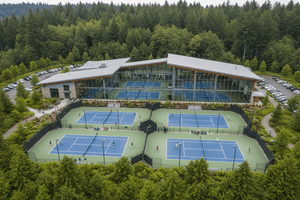
Padel is a racket sport played in doubles on an enclosed court with glass walls and metal mesh. The standard padel court measures 20m x 10m — about a third of a traditional tennis court. The 20m x 10m dimensions make it compact enough to fit in most sports facilities, which is one reason the sport has grown so rapidly worldwide. A paddle tennis court of this size is also significantly cheaper to build than a full tennis court, making it accessible for clubs and private facilities alike.
The walls are part of play. After ball bouncing off the floor, the ball can be played off the back or side glass. This is what makes padel unique and exciting — and very different from traditional tennis.
The scoring system in padel is identical to tennis — 15, 30, 40, deuce, advantage. Sets are first to 6 games, win by 2. Matches are best of 3 sets.
What Is Pickleball?
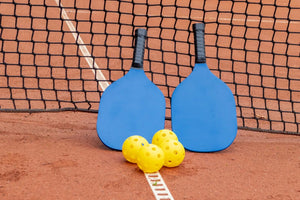
Pickleball is played on a smaller open court — 13.41 x 6.10 metres. It uses a solid pickleball and paddle combination — a perforated plastic ball and a solid composite or carbon fibre paddle. The sport was invented in 1965 using a wiffle ball and ping-pong paddles, which is why the perforated plastic ball used today still has that distinctive holed design.
The most distinctive feature is the kitchen — a 2.13 metre non-volley zone on each side of the net. Players cannot volley the ball while standing in the kitchen. The official pickleball net height is 34 inches at the centre and 36 inches at the posts — lower than a tennis net, which encourages cross-court dinking.
The scoring system in pickleball is simpler than padel. Games are played to 11 points, win by 2. Only the serving team can score a point in traditional pickleball scoring. Pickleball is also one of the most easy to pick up sports for complete beginners.