Tennis Court Dimensions: The Complete Guide (Official Size, Measurements & More)
Whether you're a beginner stepping onto the court for the first time or a seasoned player looking to brush up on the rules, understanding tennis court dimensions is fundamental. From the baseline to the net, every measurement has a purpose — and knowing them can genuinely improve your game.
In this complete guide, we cover the official size of a tennis court, all key measurements, surface types, and how dimensions vary across different formats of play.
🎾 Elite Tennis Coaching Programs — At Affordable Prices
The internet has made world-class tennis coaching accessible to everyone. The same coaches behind 5 World No.1 players — including Martina Navratilova — now offer structured online programs for players of all levels.
See All Coaching Programs →Official Tennis Court Size
A standard tennis court measures 23.77 metres (78 feet) long and varies in width depending on the format:
- Singles court: 8.23 m (27 feet) wide
- Doubles court: 10.97 m (36 feet) wide
These dimensions are set by the International Tennis Federation (ITF) and apply to all professional and recreational play worldwide.
Key Tennis Court Measurements
Here's a breakdown of every important measurement on a standard tennis court:
- Total court length: 23.77 m / 78 ft
- Singles width: 8.23 m / 27 ft
- Doubles width: 10.97 m / 36 ft
- Service box length: 6.4 m / 21 ft
- Baseline to service line: 5.49 m / 18 ft
- Net height at centre: 0.914 m / 3 ft
- Net height at posts: 1.07 m / 3.5 ft
- Doubles alley width: 1.37 m / 4.5 ft
- Centre mark length: 0.1 m / 4 inches
Tennis Court Sections Explained
A tennis court is divided into several distinct zones, each with a specific role in gameplay:
- Baseline: The back boundary of the court. Serves are initiated behind this line.
- Service boxes: Two rectangular areas on each side of the net where serves must land.
- No-man's land: The area between the service line and baseline — generally a weak position to play from.
- Net: Divides the court in half. Slightly lower at the centre (0.914 m) than at the posts (1.07 m).
- Doubles alleys: The 1.37 m strips on each side, used only in doubles play.
- Centre service line: Divides the two service boxes and determines where serves must be directed.
Tennis Court Surface Types
The official dimensions remain the same across all surfaces, but the type of surface dramatically affects how the ball bounces and how the game is played. The four main surfaces are:
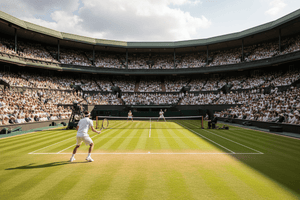
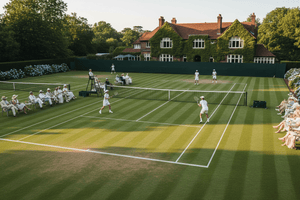
- Grass: Fast surface, low bounce. Used at Wimbledon.
- Clay: Slow surface, high bounce. Used at Roland Garros (French Open).
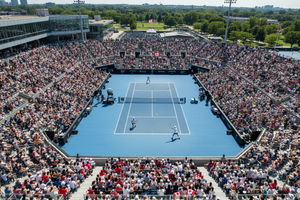
- Hard court: Medium speed, consistent bounce. Used at the US Open and Australian Open.
- Carpet: Fast indoor surface, less common at professional level.

Tennis Made Easy – Drills, Footwork, Mental Game & Training Guides
Take your tennis to the next level with our complete collection of digital training guides — covering footwork, mental game, drills, and more.
Shop the Collection →How Many Square Feet Is a Tennis Court?
A full doubles tennis court covers approximately 2,808 square feet (260.9 square metres). A singles court covers around 2,106 square feet (195.7 square metres). These figures refer to the in-bounds playing area only — the total footprint including run-off areas is larger.
Tennis Court Dimensions in Feet vs Metres
Here's a quick reference table for both measurement systems:
| Measurement | Metres | Feet |
|---|---|---|
| Court length | 23.77 m | 78 ft |
| Singles width | 8.23 m | 27 ft |
| Doubles width | 10.97 m | 36 ft |
| Net height (centre) | 0.914 m | 3 ft |
| Net height (posts) | 1.07 m | 3.5 ft |
| Service box length | 6.4 m | 21 ft |
| Doubles alley width | 1.37 m | 4.5 ft |
Are All Tennis Courts the Same Size?
Yes — at the professional and recreational level, all standard tennis courts follow the same ITF-regulated dimensions. However, mini tennis courts used for junior development are smaller, and some informal or backyard courts may vary. Always check local club specifications if you're unsure.
Tennis Court vs Pickleball Court Dimensions
A common question is how a tennis court compares to a pickleball court. A pickleball court is significantly smaller — 13.41 m x 6.1 m (44 ft x 20 ft) — which means you can fit four pickleball courts inside a single tennis court. This is why many clubs are converting or dual-lining their courts to accommodate both sports.
Final Thoughts
Understanding the exact dimensions of a tennis court gives you a tactical edge — from knowing where to position yourself to understanding why certain shots land in or out. Whether you're planning to build a court, improve your game, or simply satisfy your curiosity, these measurements are the foundation of everything that happens on court.