Padel vs Pickleball: Which Racket Sport Is Right for You?
Affiliate disclosure: This article contains affiliate links. If you purchase through these links, we may earn a small commission at no extra cost to you.
Padel and pickleball are two of the fastest-growing racket sports in the world. Both are fun, social, and easy to pick up at any age. But the difference between paddle tennis and pickleball goes deeper than most people realise. Players also often ask about paddleball vs pickleball — and while paddleball is a separate sport, the comparison helps clarify what makes pickleball unique. This guide breaks down everything — court size, rules, scoring system, equipment, and which sport suits you best. If you've ever wondered whether to choose paddle or padel, or how these sports compare to pop tennis and platform tennis, read on.
Padel vs Pickleball: Quick Comparison
| Feature | Padel | Pickleball |
|---|---|---|
| Court size | 20m x 10m, enclosed with glass walls | Open court, 13.41m x 6.10m |
| Walls in play | Yes | No |
| Paddle/Racket | Solid, perforated — often carbon fiber | Solid paddle — composite or carbon fiber |
| Ball | Depressurised tennis ball | Perforated plastic ball |
| Scoring system | Same as tennis (15-30-40) | Played to 11 points, win by 2 |
| Serve | Underhand, bounced | Underhand, no bounce |
| Kitchen/NVZ | No | Yes — 7 ft no-volley zone |
| Format | Always doubles | Singles or doubles |
| Easy to pick up? | Moderate learning curve | Very easy to pick up |
What Is Padel?
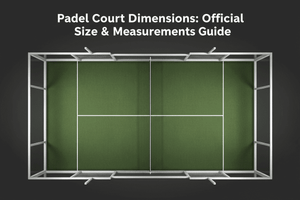
Padel is a racket sport played in doubles on an enclosed court with glass walls and metal mesh. The standard padel court measures 20m x 10m — about a third of a traditional tennis court. The 20m x 10m dimensions make it compact enough to fit in most sports facilities, which is one reason the sport has grown so rapidly worldwide. A paddle tennis court of this size is also significantly cheaper to build than a full tennis court, making it accessible for clubs and private facilities alike.
The walls are part of play. After ball bouncing off the floor, the ball can be played off the back or side glass. This is what makes padel unique and exciting — and very different from traditional tennis.
The scoring system in padel is identical to tennis — 15, 30, 40, deuce, advantage. Sets are first to 6 games, win by 2. Matches are best of 3 sets.
What Is Pickleball?
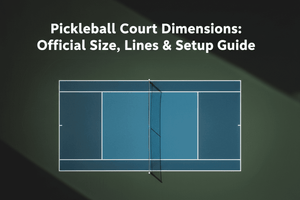
Pickleball is played on a smaller open court — 13.41 x 6.10 metres. It uses a solid paddle and a perforated plastic ball — originally inspired by a wiffle ball. The sport was invented in 1965 using a wiffle ball and ping-pong paddles, which is why the perforated plastic ball used today still has that distinctive holed design.
The most distinctive feature is the kitchen — a 2.13 metre non-volley zone on each side of the net. Players cannot volley the ball while standing in the kitchen.
The scoring system in pickleball is simpler than padel. Games are played to 11 points, win by 2. Only the serving team can score a point in traditional pickleball scoring. The serve passes to the opponent when the serving team faults. Pickleball is also one of the most easy to pick up sports for complete beginners — most people can rally within minutes of their first session.
Paddleball vs Pickleball: What's the Difference?
Players often confuse paddleball vs pickleball — they are related but distinct sports. Paddleball is played against a wall (like racquetball) using a solid paddle and a rubber ball. Pickleball is played on an open court over a net using a perforated plastic ball. The two sports share the use of solid paddles but differ in court setup, ball type, and rules entirely.
When people ask about paddleball vs pickleball, the key distinction is: paddleball is a wall sport; pickleball is a net sport — much closer to traditional tennis in structure, but played to 11 points rather than using the tennis scoring system. Pickleball is also far more easy to pick up than paddleball for most beginners.
Pickleball Versus Paddle Tennis: Key Rule Differences
When comparing pickleball versus paddle tennis, the rules are where the biggest differences appear.
Serving: In padel, the serve bounces before being hit underhand. In pickleball, the serve is hit directly underhand without a bounce. Both sports require the serve to land in the diagonal service box.
Scoring system: Padel uses the tennis scoring system (15-30-40-game-set-match). Pickleball is played to 11 points, win by 2. Only the serving team can score in traditional pickleball.
Walls: Padel courts have glass walls that are part of play. The standard padel court is 20m x 10m. A paddle tennis court is always enclosed — this is what fundamentally separates it from a pickleball court, which is open with no walls. Pickleball courts have no walls.
Kitchen rule: Pickleball has a non-volley zone (the kitchen). Padel has no equivalent rule. In pickleball, hitting the ball while standing in the kitchen on a volley is a fault.
The Difference Between Paddle Tennis and Pickleball: Equipment
Both sports use solid paddles — but they differ in size, weight, and material.
- Padel paddle: Shorter than a traditional tennis racket, solid with holes, made from carbon fiber or fibreglass. Typically 45–47 cm long. Top padel rackets — Head, Babolat, Wilson, Bullpadel & NOX are the most trusted brands on court.
- Pickleball paddle: Smaller than a padel paddle, made from composite, graphite, or carbon fiber. Typically 40–43 cm long. Top pickleball paddles — Selkirk, Joola, Franklin & Paddletek lead the market for all levels.
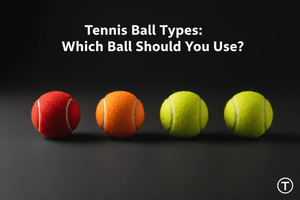
- Padel ball: Similar to a tennis ball but with lower pressure. Head, Wilson & Dunlop padel balls are the most popular choices.
- Pickleball ball: A hard perforated plastic ball with holes. Dura, Franklin & Onix pickleball balls are the top picks for indoor and outdoor play.
🎾 Gear up for your sport: Best padel rackets • Padel balls • Padel court shoes • Best pickleball paddles • Pickleball balls
Padel vs Pickleball: Scoring System Explained
The scoring system is one of the clearest differences between the two sports.
Padel scoring follows traditional tennis exactly. A game goes 15, 30, 40, deuce, advantage, game. Sets are first to 6 games. This system is familiar to tennis players but can feel complex to complete beginners.
Pickleball scoring is simpler. Games are played to 11 points, win by 2. Only the serving team can score. When the serving team wins a rally, they score a point. When the receiving team wins a rally, they win the serve — but not a point.
This side-out scoring system makes pickleball feel more strategic around the serve. Holding serve is crucial to point winning. Tournament matches are sometimes played to 11 points in a best-of-three format.

Which Sport Is Easier to Learn?
Both sports are beginner-friendly. But they suit different types of players.
Pickleball is slightly easier to start — in fact it's one of the most easy to pick up racket sports in the world. The court is smaller, the perforated plastic ball moves slower than a tennis ball, and the rules are simpler. Most beginners can rally and enjoy their first game within minutes of picking up a paddle. Games are played to 11 points, so matches are quick and satisfying.
Padel has a slightly steeper learning curve because of the walls. The 20m x 10m court and glass wall dynamics take time to master. But once you grasp the wall play, padel becomes deeply tactical and rewarding.
Padel vs Pickleball: Physical Demand
Padel is played on a 20m x 10m court and involves more movement than pickleball. The glass walls mean you're constantly repositioning after shots. It's a high-intensity sport at competitive levels — more physically demanding than traditional tennis in some respects due to the constant wall play.
Pickleball is played on a smaller court with less running. The kitchen rule keeps most play close to the net. It's more accessible for older players and those returning from injury. That said, competitive pickleball at a high level is extremely demanding physically.
Paddle or Padel, Pop Tennis or Platform Tennis: How Do They All Compare?
Many players new to racket sports get confused by the terminology. Is it paddle or padel? They are actually different sports: padel is the enclosed glass-wall sport popular in Spain and Latin America, while paddle is a broader term that can refer to several sports including platform tennis and pop tennis.
Pop tennis (formerly known as paddle tennis) is played on a smaller court than regular tennis, using a solid paddle and a depressurised ball. It's popular in the United States and is often played on the same courts as pickleball. A paddle tennis court used for pop tennis is typically the same size as a pickleball court, which is why the two sports are often played at the same facilities. Pop tennis uses an underhand serve and has a no-volley zone similar to pickleball.
Platform tennis is played on a raised, heated aluminium court surrounded by wire screens — the ball can be played off the screens, similar to how padel uses glass walls. Platform tennis is particularly popular in the northeastern United States during winter months, as the heated court makes it playable in cold weather.
So when choosing between paddle or padel, pop tennis, or platform tennis — the key differences come down to court type, ball, and whether walls or screens are part of play.
Which Sport Should You Choose?
- Choose padel if you love traditional tennis, enjoy doubles, and want a sport with walls, tactical depth, and a tennis-like scoring system on a 20m x 10m court.
- Choose pickleball if you want a fast, social, beginner-friendly sport with a perforated plastic ball, simple rules, and games played to 11 points that are quick and fun at any age. It's genuinely easy to pick up from day one.
- Choose pop tennis or platform tennis if you're looking for something closer to traditional tennis but on a smaller court — both are great options depending on your climate and location.
- Play both — many players do. The skills transfer well and both sports complement each other perfectly. Both use carbon fiber paddles at the top end, making the equipment feel familiar across both games.